Barry Hillier
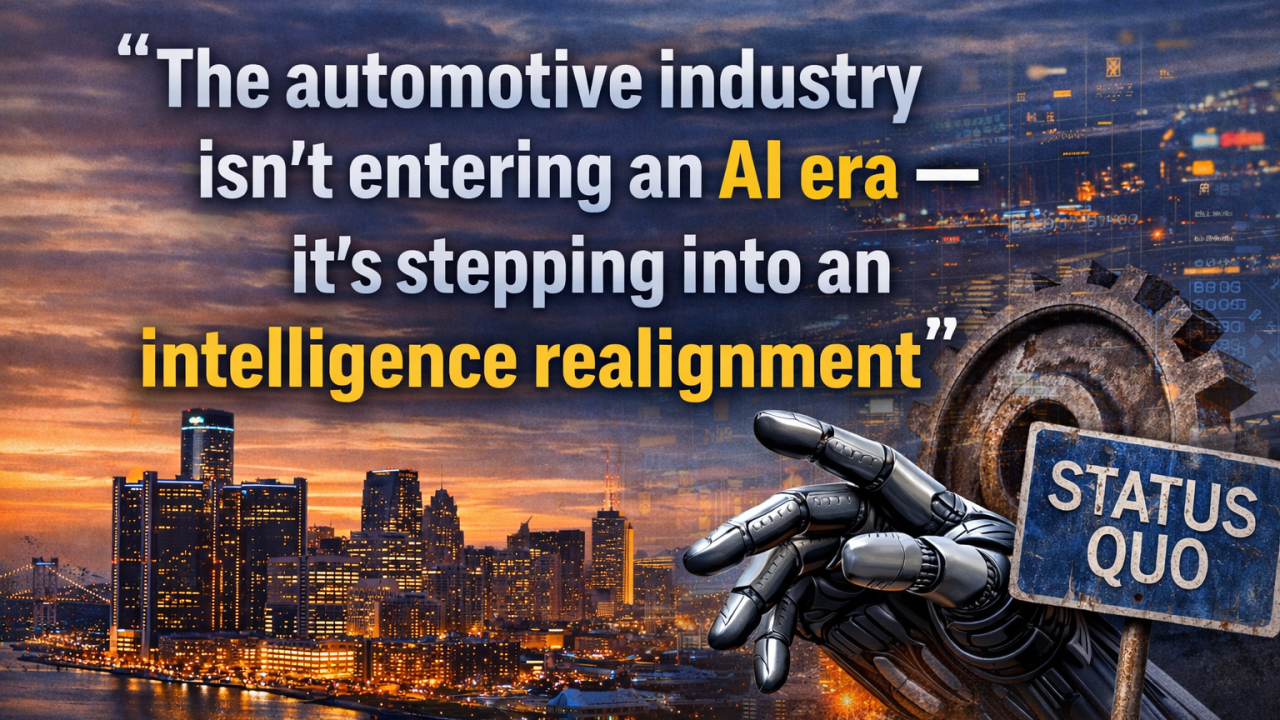
The automotive industry isn't entering an AI era — it's stepping into an intelligence realignment
Okay, let's cut through the noise for a second. Everyone's buzzing about AI, right? Stock prices jumping, headlines screaming about "the future of mobility." But honestly, if you think this is just another technology adoption cycle, you're missing the brutal truth unfolding right in front of us.

The automotive industry isn't just getting smarter tools — it's undergoing a complete intelligence realignment. And frankly, the multi-billion-dollar incumbents? They're not leading this charge. They're defending against it.
This isn't just about new tech. It's about a fundamental rewiring of what automotive intelligence actually means.
The hidden constraint nobody wants to talk about
Here's what struck me when I started digging deeper into this transformation: most automotive organizations aren't failing at AI adoption. That's not the real problem. They're constrained by something far more fundamental — their architecture.
Think about it. These companies were built on decades of fragmented systems, siloed data, and what I call "coordination debt" — layers upon layers of manual handoffs and vendor dependencies that frankly just weren't designed for intelligence. They were designed for transactions.
So when AI arrives, it gets layered on top of everything else. Another tool. Another dashboard. Another system to somehow reconcile with the existing mess.
Each department gets individually smarter, sure. But the organization? It becomes exponentially harder to run.
This is what I call the coordination ceiling — that critical point where adding more tools actually increases complexity faster than intelligence. And once organizations hit it, progress slows to a crawl, regardless of how much money they throw at the problem.
Why the giants don't move first (and can't afford to)
Large automotive players don't resist change because they lack vision. Trust me, they see what's coming. They delay because moving means breaking things that currently work.
Imagine Eleanor, CEO of "Global Auto," a company built on a century of mechanical brilliance. Her board's demanding "AI leadership," but her entire internal architecture — from engineering silos to supply chain contracts — is optimized for hardware, not software. She's staring down a transformation that feels less like an upgrade and more like demolishing a skyscraper while people are still working inside.
Re-architecting around intelligence means dismantling process architecture that took decades to build. It means renegotiating vendor dependencies, rebuilding data flows, changing decision rights, retraining entire teams. For dominant players, these aren't experimental systems — they're production environments that keep the lights on.
You don't rebuild planes mid-flight.
So they optimize the old world a little longer. They add tools. They fund pilots. They build overlays. They protect the structures that made them powerful, not realizing those same structures are what prevent intelligence from emerging.
The economics of staying fragmented
Here's where it gets really interesting — and frankly, a bit counterintuitive. There's another reason this shift is slow, and it's not just organizational inertia.
Fragmentation is profitable.
The automotive technology ecosystem has been built on a foundation of modular software, isolated platforms, licensing models, and integration services. Power lives in interfaces. Revenue lives in complexity. Control lives in silos.
Connected intelligence threatens all of that. It collapses handoffs. It dissolves dependency chains. It removes the need for entire categories of software behaviour.
So the incentive isn't to re-architect. It's to extend. To add one more feature, one more AI module, one more "intelligent" product.
Until intelligence itself becomes the product.
When data stops being leverage
Every dominant automotive organization already has massive amounts of data. What they don't have is usable intelligence.
As long as data is trapped in systems, reports trail reality, insights require manual reconciliation, and optimization happens department by department, data volume increases cost, not advantage.
The more data these organizations accumulate, the harder they become to operate. At that point, data stops being leverage. It becomes weight.
And this is where the realignment begins.
Because intelligence doesn't emerge from owning more data. It emerges from architecting how data, systems, and people coordinate in real-time.
The asymmetries that force change
Connected organizations behave differently. They don't react — they anticipate. They don't reconcile — they coordinate. They don't generate reports — they operate from shared, real-time context.
That creates asymmetries that compound:
- Speed asymmetry
- Decision asymmetry
- Experience asymmetry
- Margin asymmetry
- Partner relevance asymmetry
Dealers and dealer groups with connected intelligence will see market opportunities months earlier. They'll resolve customer issues before they surface. They'll allocate capital with predictive clarity instead of reactive guesswork.
At that point, dominance stops protecting relevance. Because the game shifts from owning systems to operating intelligence.
And here's the kicker — intelligence compounds. Fragmentation does not.
Why this takes until 2030 (and not a day sooner)
Realignments aren't technology events. They're organizational migrations.
The automotive industry won't change in a single product cycle because systems are deeply embedded, data gravity is immense, operational risk is real, and organizational behavior moves slower than technology.
What happens instead is separation over time:
- 2024–2025 established the foundation. AI entered operations. Coordination friction became visible to anyone paying attention.
- 2026 becomes the year playbooks replace pilots. Not testing tools anymore, but defining how intelligence is governed, integrated, trained, and scaled across real operations.
- 2027–2029 brings ecosystem integration. OEM coordination. Network intelligence. Cross-organization orchestration that makes individual company AI look quaint.
- 2030–2034 is when industry structure fundamentally changes. Agentic systems become standard. Vendor lock-in erodes. Intelligence-driven partnerships replace transactional software relationships.
By then, the leaders won't be those who adopted AI first. They'll be those who built intelligence architectures correctly.
The coming divide
The automotive industry is about to split — not between those who use AI and those who don't, but between those who built intelligence architectures and those who kept adding tools.
One side will operate with shared context, predictive coordination, continuous learning, and ecosystem-level visibility.
The other will still be managing handoffs, integrating systems, reconciling reports, and reacting to markets.
The gap won't be competitive. It'll be structural.
And structural gaps don't close quickly. They widen.
Why this matters right now
This transformation isn't happening to the automotive industry. It's happening because intelligence makes the old coordination model untenable.
The only open question isn't whether automotive will change. It's who will help define what it changes into.
And honestly, if you're not already thinking architecturally about intelligence — not just adopting tools, but redesigning how intelligence flows through your organization — you're not just behind. You're playing a different game entirely.
The realignment is here. The question is whether you'll lead it or watch it happen to everyone else.
About Barry Hillier
Barry Hillier is a Co-Founder and CEO of Auto Agentic (www.autoagentic.ai), where he is leading the development of the Automotive Intelligence Pyramid and the architecture behind the next era of automotive operations.
For more than twenty-five years, Barry has worked at the intersection of automotive, technology, strategy, and organizational transformation. His career began in the early days of the digital shift, where he helped global 500 companies, as well as automotive brands and dealer networks navigate their first major transition from traditional operations into digital platforms, data-driven marketing, and connected systems. That work in strategic planning and brand development gave him a front-row seat to how industries actually change—and why most technology waves fail to deliver the transformations they promise.
Barry went on to build and exit multiple automotive SaaS platforms used by dealer groups and OEMs across North America. His work has spanned agency leadership, strategic consulting, platform creation, data infrastructure, and enterprise systems design—giving him rare, inside exposure to both the business realities of dealership operations and the architectural constraints of automotive technology environments.
Today, Barry’s work is focused on a different class of problem: not how to add more AI to automotive, but how to architect intelligence itself.
Through Auto Agentic, he is developing agentic intelligence systems designed to eliminate coordination friction, unify fragmented operations, and enable organizations to move beyond isolated tools toward connected, predictive, and continuously improving intelligence environments. His research and writing explore why most automotive organizations stall at early AI maturity levels, how the “coordination ceiling” forms, and what must change architecturally, operationally, and culturally for intelligence to emerge.
Barry works directly with select dealer groups, OEM partners, and frontier AI engineering teams to design real-world agentic systems and to codify the playbooks the automotive industry will rely on over the next decade.
His writing focuses on intelligence realignment, organizational architecture, agentic systems, and the long-horizon transformation of the automotive ecosystem.
Barry is based in Toronto and regularly publishes on the future of automotive intelligence, agentic AI, and systemic industry change.