Auto Agentic Team
The Machine with a Million Knobs: What Is a Neural Network?
When we talk about artificial intelligence, it is easy to picture a glowing digital brain — a thinking entity capable of making human-like cognitive leaps inside a mysterious black box. But a neural network does not actually function like a biological brain.
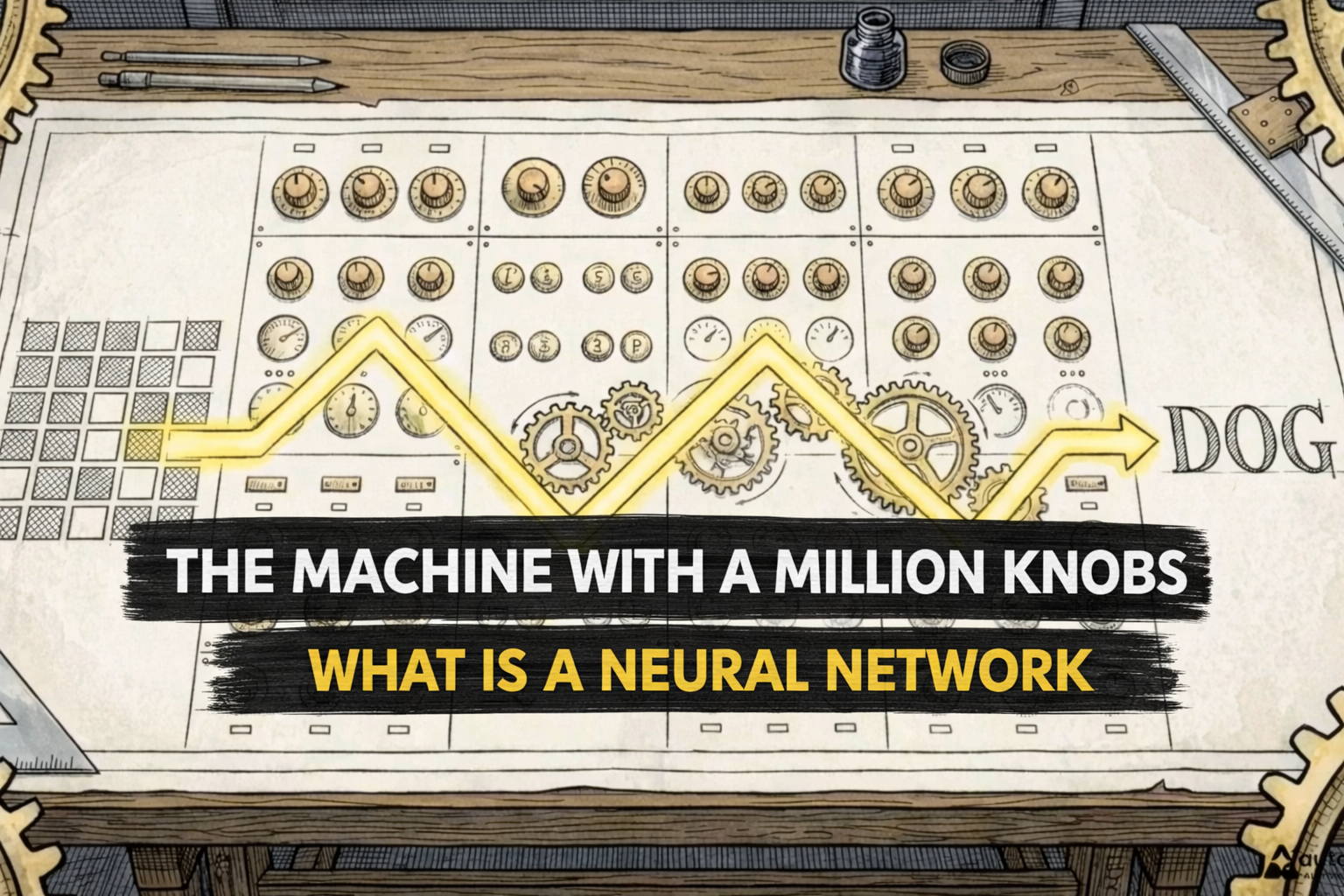
Instead, picture a massive, mechanical box stretching as far as the eye can see, completely covered in millions of tuning dials.
How Data Goes In
If we want this machine to recognize a photograph of a dog, we take that image, break it down into thousands of individual pixels, and feed the numerical value of each pixel into one side of our mechanical box. Inside, those numbers pass through the millions of dials, bouncing and multiplying chaotically until the machine spits out a guess on the other side.
Because the dials are initially set at random, the machine looks at the pixel data for a dog and confidently declares: "Toaster."
Hidden Layers: No Magic, Just Math
In a real neural network, those rows of dials are called hidden layers. There is no magic happening inside them. The entire process of deep learning is simply the act of finding the exact right combination of settings for all of those dials.
When you first build this machine, every single dial is positioned completely at random — that guarantees every initial guess it makes will be completely wrong.
The Wrongness Meter: Loss Functions
Engineers build a loss function — a mathematical "wrongness meter" that calculates the exact distance between the random guess and the correct answer. The system's single overarching objective is to force the needle on that meter down to zero.
You cannot solve this by trial and error. If you tried to find the right settings by randomly twisting millions of dials and hoping for the best, you would be twisting them until the end of the universe. Luck will not work.
Gradient Descent: Rolling Downhill
The machine requires a systematic mathematical strategy to deduce exactly which dials to turn and in which direction to reduce the error. Gradient Descent acts like a ball rolling down hills and valleys — height represents error, and the goal is the lowest geometric point.
To descend, it works backward through every dial, calculating if a left or right nudge reduces the error, then simultaneously turns all helpful dials. Then it repeats the loop: it takes in a new image, makes a slightly better guess — like "cat" instead of "toaster" — and calculates adjustments again.
Back Propagation: The Learning Loop
This continuous backward-nudging loop is called back propagation. Back propagation is the specific algorithm that calculates exactly how much each weight or bias should change to reduce the error.
When people say a machine is "learning," they are describing this iterative mechanical correction.
Activation Functions: Keeping the Math in Check
As the machine adjusts millions of dials over thousands of cycles, the math can easily run out of control without boundaries. The cumulative adjustments would quickly result in useless, infinitely large numbers.
To prevent this, the system uses an activation function — a mathematical filter designed to squish any extreme dial setting into a clean, readable metric. It takes an infinitely wide horizontal axis of raw data and forcefully compresses it, ensuring the output always stays strictly between zero and one.
Bounding the numbers between zero and one allows the machine to express its output as a probability. A result of 0.99 translates directly into: "I am 99% sure this is a dog."
A neural network never operates in absolute certainty. It speaks entirely in the language of calculated probabilities.
Millions of Mistakes Make Mastery
Picture this entire mechanical process operating at superhuman speeds. The machine processes millions of images, making microscopic dial adjustments in fractions of a second as it perfects its tuning. The guesses evolve rapidly — from "Wolf," to "Fox," and finally arriving accurately at "Dog."
The machine has no concept of what a dog actually is. It does not understand fur, ears, or snouts. It has merely discovered the precise, static, mathematical configuration of dials that perfectly translates a specific grid of pixels into a correct label.
Artificial Intelligence possesses no conscious thought and holds no secret wisdom. It is an elegant machine that achieves greatness purely by surviving millions of carefully calculated mistakes.