Bill Playford
Why Architecture Matters in AI
When reading the initial drafts of Barry Hillier’s book, From the Transactional Age to the Intelligence Age, the word architecture kept popping up over and over. Admittedly, I was a little nervous that homebuilders would start flooding our site. But, as I kept reading, the idea of architecture as it applies to AI, or business in general, started to make way more sense. Now, I feel like it’s the only way to describe it.
Not many know this, but I wanted to be an architect when I grew up. It’s never too late, right? Seriously, though, nothing fills me with more awe and inspiration than a perfectly designed space. Buildings are my first love, not cars. I’ve stood inside thousand-year-old cathedrals, gilded-age masterpieces, and marvels made from glass and steel. You may have stood somewhere and had a feeling well up in you that you couldn’t describe, something that struck you almost like an emotion. That feeling in real architecture is the echo of not only the genius who designed it, but also of the sum total of all the great minds who influenced them. When we view AI in our organization in the same way, the value will be monumental.
Like many architecture aficionados, Frank Lloyd Wright (1867-1959) is my favorite. His timeless creations certainly caught my eye, just as they have most others who have seen his work. However, it wasn’t until I started reading his books and understanding his design philosophy that he transitioned from someone I admired to a hero. If you’ve ever seen a video of me in my office, you might have noticed the Lloyd Wright books over my shoulder, and I’ve accumulated quite a collection of memorabilia over the years, including some architectural salvage. While, in many ways, he wasn’t the best human being to grace the Earth, his comprehensive vision and absolute obsession with every conceivable variable made an indelible and lasting contribution to nearly every building you see today.
AI Has No Lasting Value if It’s Painted on the Walls
How a building looks is not architecture. Without diving deep into the principles of marginal utility, most structures you see today are purely functional. A house keeps you warm and dry. An office building condenses workers into a usable space. If the walls were built with Milwaukee tools, DeWalt tools, or Ryobi tools, it doesn’t matter one bit. The doors are oriented to the sidewalk for convenient entrance. Whichever name is on the address doesn’t change what it is. Whatever the structure needs to be, it just has to do the bare minimum to be complete.
Real, bona fide, architecture is the product of continuous thought. Every possible variable is taken into consideration before the first stroke of the pen or move of the mouse. How the foot traffic will flow. The views from the windows, both inside and out. How nature will interact with the structure, whether it is wind, precipitation, natural disaster, or just how the trees will mature around it. The materials that will be used, the structural strength they will provide, and how those materials will change over time. It’s not a few of these things. It’s not most of these things. It’s ALL of these things, and so much more. The paint on the walls makes little difference.
HBO recently did a multipart special on the last Lloyd Wright house to be completed, which demonstrates just how intense the visualization and planning can be. From the placement of the home to its orientation relative to the foliage, and from the fixtures and furniture to the overall layout, everything was laid out in one cohesive vision. My favorite part was an awning design, which accounted for the solar equinoxes to maximize solar gain throughout the seasons. Mind you, this was done long before AI. Instead, everything was absolutely on purpose, with the absolute passion of a generational mind.
AI Has to Be Structural
Like architecture, AI must be part of every facet of the business to unlock its true value. AI has to be the centerline to make things round or square. AI has to be the concrete for the footings, the studs in the wall, and the shingles on the roof. AI has to be the wiring, the switches, and the fuse box. AI has to be the screws in the drywall, including the millimeter dimensions, the anodized coating, the pitch of the threading, and the metal alloy, right down to the molecular bonds that hold it all together.
As we continue to move forward in this evolving landscape of artificial intelligence, the true strength lies in the systemic interplay among intelligent systems, as well as how that functionality accumulates intelligence over time. A screw is useless by itself. That wall stud can’t stand on its own. A bale of shingles will blow away in the first gusts of a storm. A bag of concrete is basically just dust. Yet, when properly combined, it’s where you sleep at night. But, again, that’s just the marginal value.
AI Beyond Marginal Value
The best architecture is worth vastly more than just the sum of its parts. To commission Frank Lloyd Wright to design your home cost a princely sum when he was still alive, and that meant not being able to choose your furniture or the color of the walls. To purchase a preserved Frank Lloyd Wright house today would cost you many times what it would cost to build the same-sized home from scratch. And, while many have tried to do that same thing, it never, ever, looks and feels the same. It lacks the spirit that comes from within.
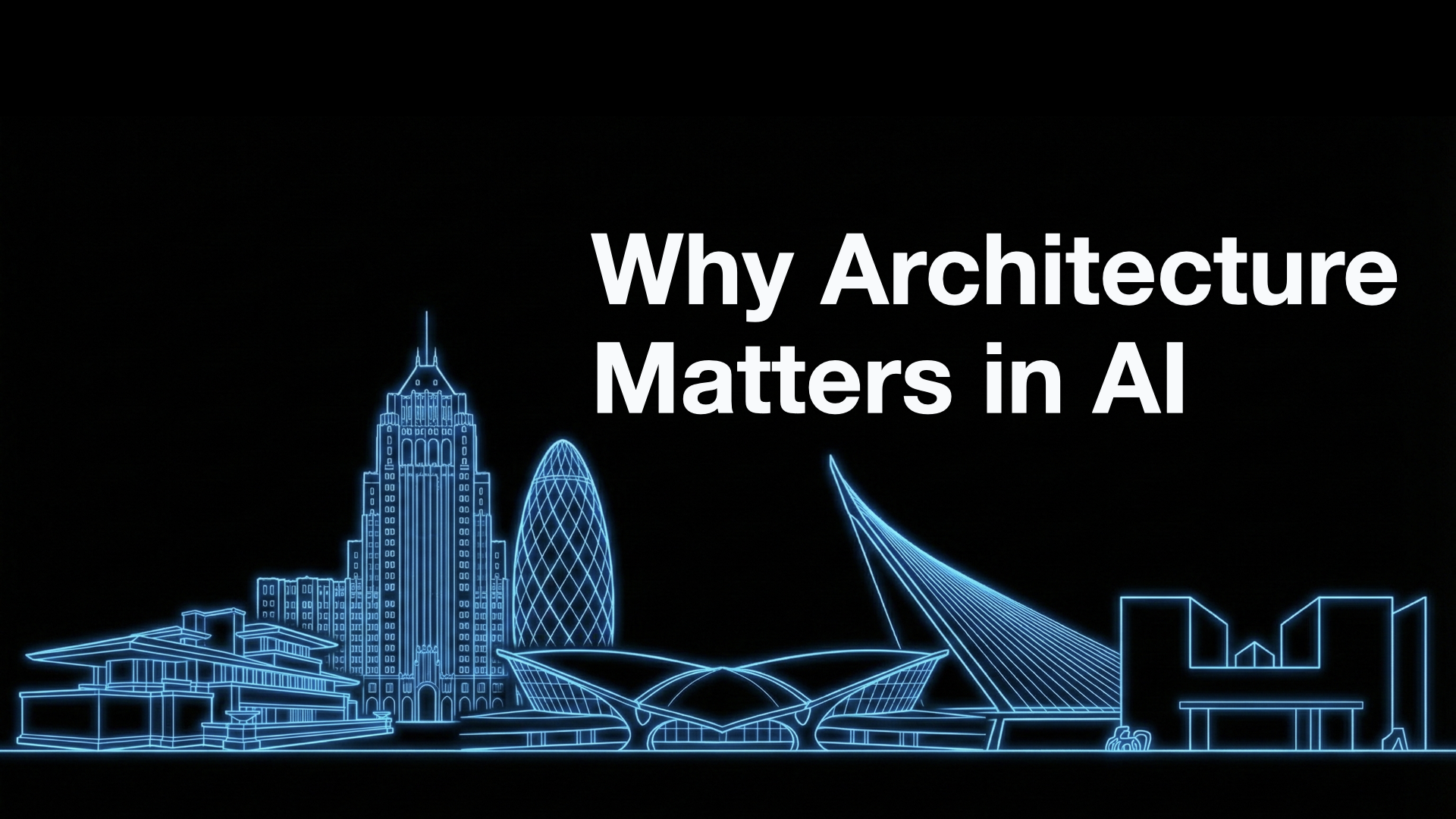
The same can be said for many architects besides Wright. High rises and skyscrapers from the likes of Albert Kahn, Mies van der Rohe, Renzo Piano, and Norman Foster are indelibly etched into the identities of the cities in which they sit. I.M. Pei and Frank Gehry’s designs have sparked imaginations for decades, becoming just as much a part of museums as the priceless contents inside. Eero Saarinen, Santiago Calatrava, and Zaha Hadid transformed civic structures like airports and bridges into awe-inspiring experiences for all. While these buildings still let the light in and keep the elements out just like any other structure, the value that they provide is literally immeasurable. It's the difference between the actual Paris and the casino by the same name in Las Vegas. AI as architecture will undoubtedly be more valuable in a similar way.
It’s not just about the individual strengths of these legendary architects. It’s the continuity of knowledge, influence, and imagination that’s been passed down from generation to generation since time immemorial. Quite literally, thousands of years of knowledge are preserved, being expressed in ways we totally take for granted, yet cannot be replaced by anything new. Countless generations of architects will be inspired by the great works of the ancient past and the present, taking all of those lessons of their predecessors, and putting them to work in ways we can’t conceive of in the future. It's one continuous flow of knowledge that doesn't have to start over. You can't place a monetary value on that.
If a business is just looking for quick AI fixes, the return will be low. Changing the carpet won’t change the floor's load-bearing capacity. Replacing the windows may improve insulation, but it won’t change the view. Building a new façade certainly won’t change the productivity of those working inside. In the superficial, the sum of the parts barely adds any value to the ground they sit on. The return will only be high when all parts of the business are meticulously evaluated, all of the lessons are preserved, any structural limitations are demolished, and AI is used throughout the reconstruction. The difference in financial return will be like a portfolio of skyscrapers that creates generational wealth, not a savings account.
The ultimate value from AI will not be what’s on the surface, nor will it be the sum of the parts. The true return will come from intentionally designing AI into every element of a business while retaining and applying all of the great human lessons from the past. From the foundation to the measurements to how people will flow throughout the structure to the view from the top, incorporating AI will require the same obsessive focus as an architect. If done wrong, it can easily collapse and sink into a hole. If done right, it can be a shining beacon for all to see.
Start Designing Today
Commit to Comprehensive Integration
Reject the quick-fix mentality and prepare for the obsessive, detailed work required to build AI architecture that creates generational value.
Preserve Your Institutional Knowledge
Document and incorporate decades of human expertise into your AI framework before you start designing anything new.
Design Before You Deploy
Like Frank Lloyd Wright planning for solar equinoxes, map out how AI will interact with every aspect of your operation before making your first implementation.
Make AI structural, not supplemental
Identify where AI can become the "concrete foundation" and "wall studs" of your business rather than just another tool in the toolkit.
Stop painting AI on the walls
Audit your current AI initiatives and eliminate any superficial implementations that don't integrate with your core business processes.