Barry Hillier
Why your dealership's AI strategy is failing: the Automotive Intelligence Pyramid
An Auto Agentic perspective on AI maturity, based on our experience building and implementing AI solutions across the automotive ecosystem
The $50 billion wake-up call
Here's what nobody wants to talk about: The automotive industry has poured over $50 billion into AI initiatives in 2024 and 2025, yet 42% of companies just threw in the towel before 2026 even started. In dealerships specifically, over 75% of AI-generated financing quotes are still wildly inaccurate, and 78% of dealers have no clue how to use the predictive data their systems generate.
The brutal truth? Most automotive organizations think they're climbing the AI ladder, but they're standing on the first two rungs, mistaking chat for intelligence.
At Auto Agentic, after working directly with dealerships, OEMs, and automotive technology leaders—like the time a major dealer group proudly showed off their "AI revolution" that turned out to be a glorified FAQ bot—we've seen this pattern everywhere. The gap isn't just in expectations. It's a fundamental misunderstanding of what AI maturity actually means.
The false confidence trap
Walk into any dealership today, and you'll hear it: "Oh yeah, we're doing AI." They'll point to ChatGPT on someone's desktop, a chatbot on their website, or AI-generated social posts.
But here's the dirty secret: it's widespread false confidence. Leaders genuinely believe they're transforming their operations when, operationally, nothing has changed. We've watched this create real business risks—strategic decisions made on the assumption of AI capabilities that don't exist.
This isn't just wasted money. It's a competitive disadvantage compounding daily while organizations that understand true AI intelligence pull ahead.
What we learned building real automotive AI
After years developing AI agents specifically for automotive operations, working with dealership data, and watching both spectacular wins and epic failures, we discovered something critical: AI maturity isn't about smarter tools—it's about how intelligently your organization and the broader ecosystem can think, learn, and act.
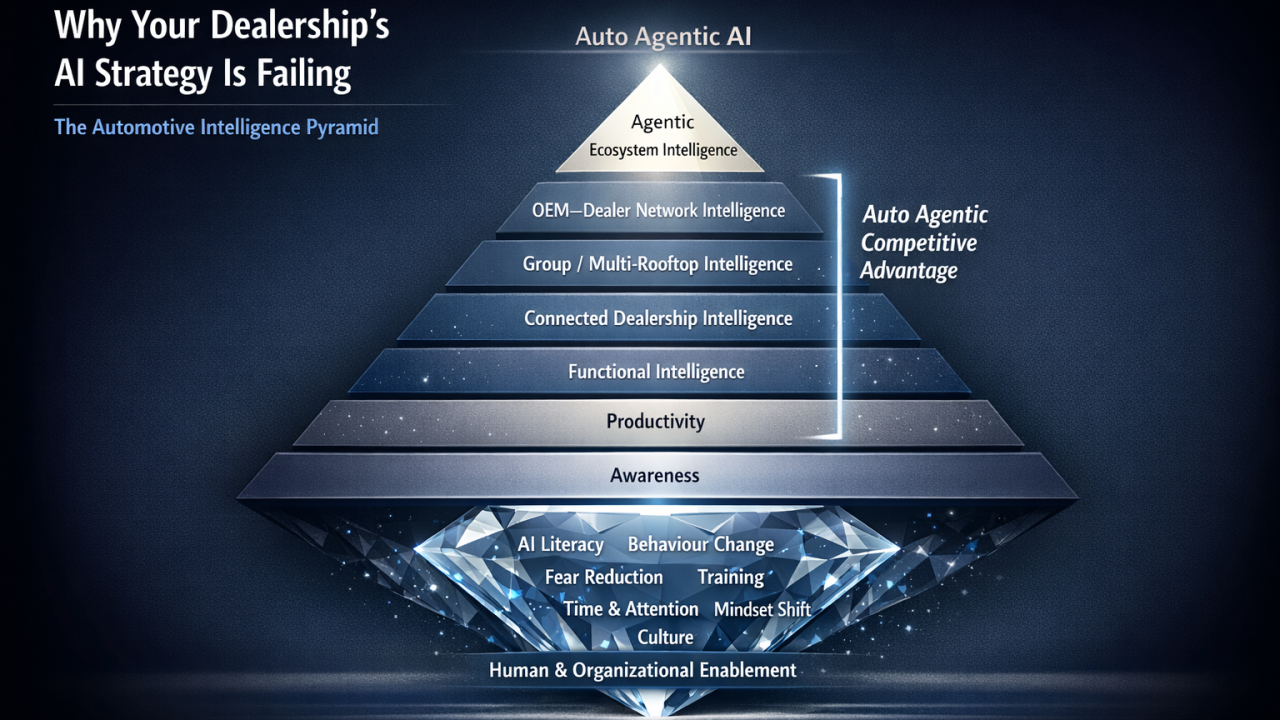
Most solutions today operate at the basic levels of AI maturity, offering chatbots and single-purpose tools that barely scratch the surface of what's possible. The Automotive Intelligence Pyramid represents our Auto Agentic framework for understanding why AI initiatives fail and how organizations can build genuine AI capability.
Human & organizational enablement: the invisible foundation
Before we climb the pyramid, let's talk about what holds it up. Human & Organizational Enablement is the foundation beneath every level—and the single most significant factor determining whether AI succeeds or crashes.
While AI maturity gets framed as a technology challenge, our experience shows it's fundamentally a human and organizational transformation. You can deploy tools quickly. Building capability? That takes time.
This foundation represents the deliberate development of individual confidence with AI, new behaviours and ways of working, leadership alignment and trust, and cultural readiness for continuous intelligence. Without it, organizations stall—regardless of how advanced their technology stack appears.
What actually enables progress

AI Education and Organizational Change is critical for AI adoption to begin.
Individual AI education. People need to understand what AI is, what it isn't, and how it applies to their role. Not technical training—practical, role-relevant literacy that removes mystery and builds confidence. Most organizations skip this entirely, assuming people will "figure it out." They don't.
Fear reduction. Fear kills AI adoption—fear of replacement, exposure, complexity, losing control. In the automotive industry, where relationships and experience matter deeply, this fear runs particularly strongly. Successful organizations address it directly through transparency, positioning AI as an augmentation, and creating safe ways to engage.
Behaviour change. AI only creates value when it changes how work actually happens. This means asking better questions, trusting evidence over instinct, and shifting from reactive to proactive decision-making. For an industry built on intuition and relationships, this represents a fundamental shift that requires careful nurturing.
Time & attention management. AI introduces new ways of working, not just new tools. Teams must relearn how to allocate attention, reduce low-value work, and create space for insight and action. Most dealerships pile AI on top of existing workflows rather than reimagining them.
Training & skill development. As intelligence becomes continuous, skills must evolve continuously. This includes ongoing training, role-specific capability building, and leadership upskilling for AI-augmented decision-making. It's not a workshop—it's a cultural commitment.
Mindset shift. The most significant transition is mental: from reports to reasoning, from static dashboards to living systems, from isolated performance to connected outcomes. This challenges decades of automotive business culture.
Culture change. At scale, AI success becomes cultural. Organizations reaching higher pyramid levels share common traits: curiosity over defensiveness, evidence over opinion, and learning over perfection. This cultural foundation separates climbers from those stuck at the bottom.
The Seven Levels of Automotive Intelligence

Most Dealerships never get past the first three levels.
Level 1: Awareness - "AI equals chat"
This is where most dealerships live today.
AI gets understood as something you talk to—Google, but smarter. People write emails, generate scripts, and ask general questions. But there's no system integration, no business context, no governance.
The primary risk? False confidence—believing "we're doing AI" when nothing operationally changes. Most dealerships and automotive professionals are stuck here, treating AI like a slightly smarter search engine.
What's required to advance: Basic AI literacy across the organization and a clear understanding that chat tools are just the starting point, not the destination.
Level 2: Productivity - "AI as my personal assistant"
AI becomes a personal productivity tool where value gets measured purely in time saved. Marketing copy generates faster, SOPs get drafted quicker, and reports are summarized automatically.
But here's the catch: efficiency improvements don't necessarily translate into improvements in decision quality. The work stays human-driven, disconnected from live data, completely siloed. You're working faster, not smarter.
What's required to advance: Recognition that individual productivity gains don't scale to organizational intelligence. You need systems thinking, not just better personal tools.
Level 3: Functional intelligence - "AI understands my department"
This is where many dealerships think they've arrived. Sales AI, service AI, HR AI, marketing AI—each department gets its specialized tool. Dashboards get smarter, decisions improve within silos.
Here's the trap: organizations accumulate expensive AI point solutions that refuse to talk to each other. Your sales AI doesn't know what service was discovered about a customer. Your marketing AI can't see which parts of demand patterns are revealed. You've got islands of intelligence in an ocean of disconnection.
What's required to advance: Breaking down data silos and building systems that share context across functions. This requires both technical integration and cultural willingness to share information across traditional boundaries.
Level 4: Connected dealership intelligence - "AI understands how we work as a system"
This is the first true structural leap.
Performance becomes cross-functional. Problems don't live in one system. Sales ↔ Service ↔ Parts ↔ F&I start operating with a shared context. CRM + DMS + LMS + operational data create a unified intelligence layer.
The outcome? Fewer opinions, more evidence. Leadership starts trusting AI outputs because they're based on complete pictures, not departmental fragments.
Many dealers believe they're here, or are heading there. Very few actually are. The technical complexity of true data unification, combined with the organizational complexity of cross-functional collaboration, makes this level significantly harder than it appears.
What's required to advance: Enterprise-grade data architecture, AI systems designed for collaboration (not competition), and a cultural shift toward shared accountability for customer outcomes rather than departmental metrics.
Human enablement requirement: Teams must learn to work across traditional boundaries, trust shared data, and make decisions based on complete context rather than departmental metrics. This challenges established power structures and requires strong leadership commitment.
Level 5: Group/multi-rooftop intelligence - "AI understands performance across locations"
Scale reveals patterns that single rooftops can't see. Cross-location benchmarking, regional pattern detection, talent and process comparisons become possible. Standardization versus localization: insights emerge from data, not intuition.
This is where data becomes strategy. Dealer groups gain real leverage when they can see structural issues, measure training effectiveness across locations, and optimize based on aggregate performance patterns instead of gut feelings and quarterly reports.
What's required to advance: Sophisticated data governance frameworks that enable secure sharing while maintaining competitive sensitivity. Technical infrastructure that can handle multi-tenant complexity while preserving performance and privacy.
Human enablement requirement: Leaders must shift from protecting territorial information to sharing insights for collective advantage. Local managers must balance standardization with market-specific needs. This requires new frameworks for collaboration and mutual accountability.
Level 6: OEM-dealer network intelligence - "AI understands the ecosystem"
This level represents an entirely different class of intelligence. The automotive industry is understood as a connected network, not a hierarchy. Performance gets analyzed end-to-end with contextualized, permissioned data flows.
What becomes possible:
- OEMs understand why performance varies, not just that it does
- Dealers see how programs, policies, and incentives land in reality
- Training and initiatives connect directly to measurable outcomes
- Early detection of systemic risks and opportunities across the entire network
Critical distinction: This isn't surveillance. It's shared intelligence built on governance frameworks and mutual trust.
What's required to advance: Breakthrough collaboration models that transcend traditional OEM-dealer power dynamics. Sophisticated permission and privacy controls that enable insight sharing without competitive exposure. Cultural transformation at both OEM and dealer levels.
Human enablement requirement: Both OEMs and dealers must develop new frameworks for collaboration, data governance, and mutual accountability that transcend traditional power dynamics. This requires a fundamental reimagining of how the automotive ecosystem can work together.
Level 7 (apex): Agentic ecosystem intelligence - "AI works with the industry continuously"
This is the future state we're building toward.
AI becomes not a tool, but a system of collaborating agents. Intelligence operates between meetings, not just after reports. Multi-agent systems analyze, validate, and critique one another while continuously monitoring performance, risk, and opportunities across the entire ecosystem.
The human role shifts to direction, judgment, and leadership. AI handles analysis, synthesis, signal detection, and scenario testing. Institutional knowledge persists beyond individuals, and the ecosystem learns faster than any single organization could alone.
The outcome? Durable, compounding competitive advantage that becomes increasingly difficult for outsiders to replicate because it's built on network effects and continuous learning loops.
What's required to advance: Multi-agent AI architectures, continuous learning systems, and governance frameworks that can handle autonomous intelligence while maintaining human oversight and control. This level requires fundamental reimagining of how intelligence and decision-making work in large, complex systems.
Human enablement requirement: Humans must develop entirely new skills to direct AI systems, interpret multi-agent insights, and maintain oversight of autonomous intelligence networks. This represents the most significant transformation of human roles in the pyramid.
The 2026 awakening: expectations crash into reality
As 2025 ends and 2026 begins, the automotive industry faces a harsh reckoning. The gap between AI expectations and reality has never been wider, and it's becoming impossible to ignore.
What everyone expected: AI would seamlessly integrate into dealership operations, delivering immediate ROI and transforming customer experiences.
What we're actually seeing:
- Chatbots that give customers wrong information more often than right information
- Data is trapped in expensive silos that cost more to maintain than they deliver in value
- Staff who can't leverage AI effectively because nobody taught them how
- Integration costs that exploded way beyond initial projections
- Customer satisfaction that often drops rather than improves
This gap exists because the industry has been solving for Levels 1-3 while the real value lives in Levels 4-7. We've been building smarter hammers when we need connected intelligence. More critically, we've been deploying technology without building the human foundation that makes it actually work.
The breakthrough insight that changes everything
The fundamental paradigm shift isn't from basic chat to better chat. It's from isolated AI to connected intelligence to agentic ecosystem intelligence.
But the more profound shift is human: from individual efficiency to organizational intelligence, from departmental optimization to ecosystem collaboration, from technology adoption to capability transformation.
Most automotive organizations are competing in the shallow end while the deep end remains largely unexplored. The companies that figure out Levels 4-7 first won't just have a competitive advantage—they'll be playing an entirely different game.
Why current approaches hit the ceiling
Here's what we've observed: most AI solutions today are designed for the bottom of the pyramid. They create better chatbots, smarter individual tools, and more efficient departmental solutions. By design, these point solutions reinforce the very silos that prevent the emergence of true organizational intelligence.
Moving up the pyramid requires fundamentally different thinking:
- Enterprise-grade data architecture that unifies instead of fragments
- AI agents designed for collaboration, not competition with each other
- Systems built for continuous learning and adaptation, not just task completion
- Governance frameworks that enable sharing while protecting privacy and competitive advantage
- Integration that enhances existing investments rather than requiring expensive replacements
- Human enablement programs that prepare organizations for each level of transformation
Most importantly, it requires recognizing that AI maturity is fundamentally about organizational maturity. The technology follows the transformation, not the other way around.
Our approach: building for the full pyramid
Auto Agentic was designed from day one to enable the higher levels of automotive intelligence. Our approach differs because we understand that reaching Levels 4-7 requires more than just better technology:
- Ecosystem thinking: Instead of building departmental tools, we build agents that collaborate across the entire dealership system and beyond.
- Unified data architecture: Our platform unifies data sources and creates shared intelligence rather than adding more expensive silos to maintain.
- Human enablement integration: We don't just deploy tools—we help organizations build the capability to use them effectively at each level.
- Gradual sophistication: We meet organizations where they are but architect toward where they need to go, ensuring each step builds a foundation for the next.
- Automotive-native design: Every agent and integration reflects a deep understanding of how automotive businesses actually work, not generic business processes.
Our goal isn't to sell you tools for Level 1-3 problems. It's to help you build the capability for Level 4-7 transformation that creates a lasting competitive advantage.
Where do you really stand?
Here's the uncomfortable question every automotive leader must answer honestly: Where does your organization truly sit on the Automotive Intelligence Pyramid?
Not where you want to be.
Not where you hope to be.
Not where your last vendor demo suggested you could be.
Where you actually are, right now, today.
Ask yourself:
- Do your people understand AI beyond "smart Google"?
- Have you addressed the fear and resistance that kill AI adoption?
- Are you measuring behaviour change, not just tool deployment?
- Do you have the cultural foundation for continuous learning?
- Can your AI tools share context across departments?
- Are decisions based on complete data or departmental fragments?
- Do you have the governance frameworks for higher levels of intelligence sharing?
- Can you see patterns across multiple rooftops, or are you stuck in single-location thinking?
- Do you have the collaboration models needed for ecosystem-level intelligence?
Because 2026 won't be forgiving. It will punish organizations that mistake motion for progress, tools for intelligence, isolated efficiency for genuine transformation.
The pyramid doesn't lie. Your current position determines your future potential. In an industry where the gap between leaders and followers gets measured in billions of dollars and millions of customers, knowing exactly where you stand isn't just helpful—it's survival.
Our experience suggests that organizations willing to honestly assess their position and commit to climbing systematically will find a significant competitive advantage in the levels that most solutions can't reach. But only if they build the foundation first.
The Automotive Intelligence Pyramid represents Auto Agentic's framework for understanding AI maturity in the automotive ecosystem, developed as we continue to build, implement, and observe AI solutions across the automotive ecosystem. Organizations that master Levels 4-7 don't merely 'use' AI—they become intelligence-driven enterprises that learn, adapt, and outmaneuver competitors at the speed of data. Our mission is to help automotive organizations reach these transformative levels through technology that unifies, human enablement that prepares, and partnerships that sustain the climb.
Ready to discover where your organization truly stands and what it takes to reach the next level? Let's start the conversation.