Barry Hillier
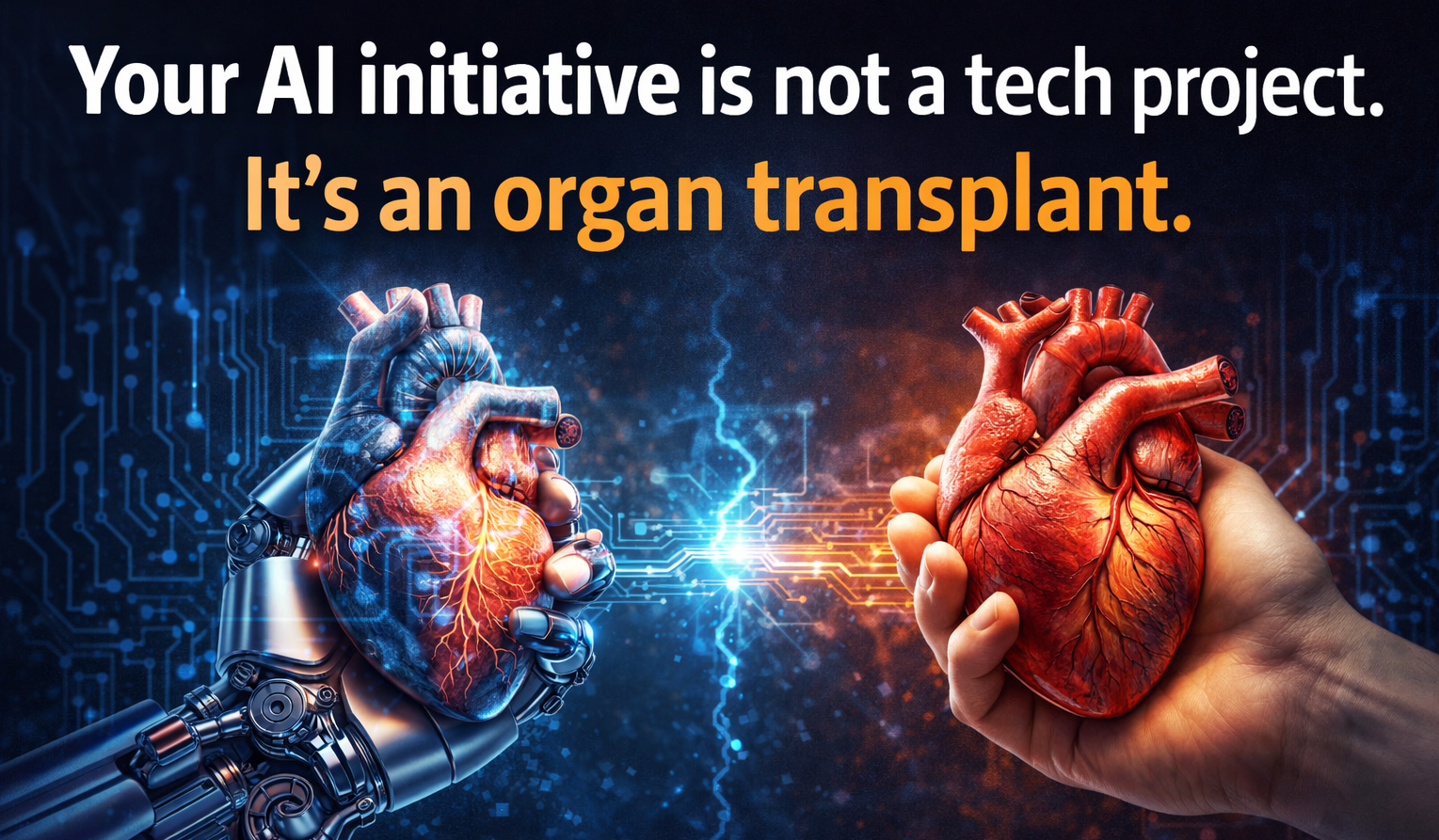
Your AI Initiative Is Not a Tech Project. It’s an Organ Transplant.
I once watched a brilliant AI model die quietly on a server.
It was technically exceptional. Built by a world-class team. Designed to solve a multi-million-dollar operational problem. On paper, it worked.
In reality, it was slowly ignored.
Not because it was wrong — but because the organization had no way to absorb it.
The system produced insights no workflow could act on. It surfaced signals no team owned. It recommended actions no department could coordinate. And so, like a transplanted organ without a compatible host, the corporate “immune system” rejected it.
Not violently.
Silently.
This is the story of most enterprise AI initiatives.
They don’t fail because the technology doesn’t work.
They fail because the organization isn’t architected to live with intelligence.
Recent research from MIT’s Center for Information Systems Research (CISR), based on the analysis of 721 companies and executive interviews, confirms what many of us have experienced firsthand: most AI initiatives struggle to scale beyond pilots or deliver sustained business value.
But the most important insight isn’t the failure rate.
It’s why some survive.
The organizations that succeed don’t “install” AI.
They prepare the entire organization for a transplant.
They understand you can’t drop a new organ into a body that hasn’t been redesigned to support it.
Understanding the stages of AI integration
MIT CISR outlines a four-stage AI maturity model that maps how organizations progress — and where performance accelerates or stalls.
Seen through an operational lens, these stages mirror what we consistently observe inside automotive organizations:
Stage 1: Finding a donor
Exploration. Policies. Pilots. Chat tools. Early experiments.
Organizations feel like they are “doing AI,” but operationally nothing changes. Financial performance often lags. They’re searching for the right organ, but the body isn’t improving yet.
Stage 2: Pre-op preparation
Targeted pilots. Departmental tools. Initial value creation.
Performance improves, but remains fragmented. AI optimizes locally while coordination remains manual. Each department gets smarter. The organization becomes harder to run.
This is where most organizations stall.
Stage 3: The surgery and integration
This is the inflection point.
AI stops being a project and starts entering the bloodstream of operations. Data begins connecting. Workflows start coordinating. Decisions improve because context improves.
This is where financial performance meaningfully separates.
Stage 4: Thriving post-transplant
The elite tier.
AI is no longer something the company uses — it’s something the company is built around. Intelligence flows across functions. Learning compounds. Many of these organizations begin turning intelligence capability into competitive advantage and new revenue.
The critical distinction MIT surfaces — and that we see constantly — is this:
The leap is not technological.
It’s architectural.
The real cause of rejection
Most AI efforts today fail for the same biological reason transplants fail.
The organ may be healthy.
But the body is incompatible.
Legacy organizations were designed for transactions, not intelligence.
- Siloed systems.
- Fragmented data.
- Departmental KPIs.
- Manual handoffs.
- Static reporting cycles.
So when intelligence arrives, it gets layered on top.
Another tool.
Another dashboard.
Another integration.
Each system gets smarter.
The organization accumulates coordination debt.
Eventually, organizations hit what we now clearly recognize as the coordination ceiling — the point where adding more tools increases complexity faster than intelligence.
Beyond that ceiling, no matter how advanced the models are, the organization cannot metabolize them.
The organ may function.
The body cannot.
The surgeon’s guide to a survivable transplant
When we look at both MIT’s research and our own experience building and deploying agentic systems inside real operations, the pattern is remarkably consistent.
Successful AI transformations are never model-first.
They are physiology-first.
1. The diagnosis: start with a life-threatening condition
The organizations that succeed don’t start with “Where can we use AI?”
They start with “Where is coordination failing at a scale that is costing us real advantage?”
The winning implementations attack problems that everyone agrees are bleeding value: fragmented customer journeys, disconnected sales and service intelligence, misaligned operations, broken handoffs, delayed decision systems.
AI becomes powerful when it is used to rebuild circulation, not automate tasks.
2. The surgical team: get out of the lab
AI built in isolation is almost always rejected.
The organizations that succeed embed intelligence development inside the operational body. Data scientists alongside operators. Engineers alongside managers. Architecture debated where work actually happens.
Not to improve models.
To redesign how intelligence flows.
3. The recovery plan: one system at a time
No organization survives ten transplants at once.
The elite performers master one complex integration, then turn it into repeatable physiology — shared data layers, governance models, operating rhythms, human capability, trust in machine-supported decisions.
This becomes the immune system for the next stage.
4. The human in the loop: the body must trust the organ
Even the most advanced intelligence systems only survive when humans change how they work.
- Trust.
- Literacy.
- Behavior.
- Decision models.
- Leadership posture.
When people experience intelligence reducing friction rather than adding complexity, adoption becomes biological, not mandated.
This is the real anti-rejection drug.
Why this takes years, not quarters
Real transplants don’t end in the operating room.
They unfold in recovery.
Intelligence transformation is not a technology event.
It is an organizational migration.
- Systems are embedded.
- Data gravity is real.
- Operational risk is real.
- Power structures are real.
- Human behavior changes slowly.
What happens instead of sudden disruption is separation over time:
2024–2025 exposed the limits.
AI entered operations. Coordination friction surfaced.
2026 becomes the year playbooks replace pilots.
Organizations either architect intelligence deliberately — or permanently lock in fragmentation.
2027–2029 brings ecosystem integration.
Dealer groups. OEMs. Networks. Multi-agent coordination.
2030 onward is where industry structure changes.
Intelligence becomes standard.
Vendor models erode.
Coordination becomes competitive advantage.
By then, the leaders won’t be those who “used AI first.”
They’ll be the ones who rebuilt their organizational physiology correctly.
Are you preparing the body — or collecting organs?
What strikes me most, reviewing both MIT’s research and what we see daily inside automotive, is this:
AI transformation is not primarily a technology challenge.
It is an organizational compatibility challenge.
The gap between those who stall and those who separate is not algorithms or access to data.
It is whether intelligence has somewhere to live.
AI fails when it is treated like software.
It succeeds when it is treated like a vital system that requires the entire organization to adapt.
The question leaders should be asking isn’t:
“Which AI should we deploy?”
It’s:
“Is our organization architected to support intelligence at all?”
Because intelligence is not installed.
It’s transplanted.